
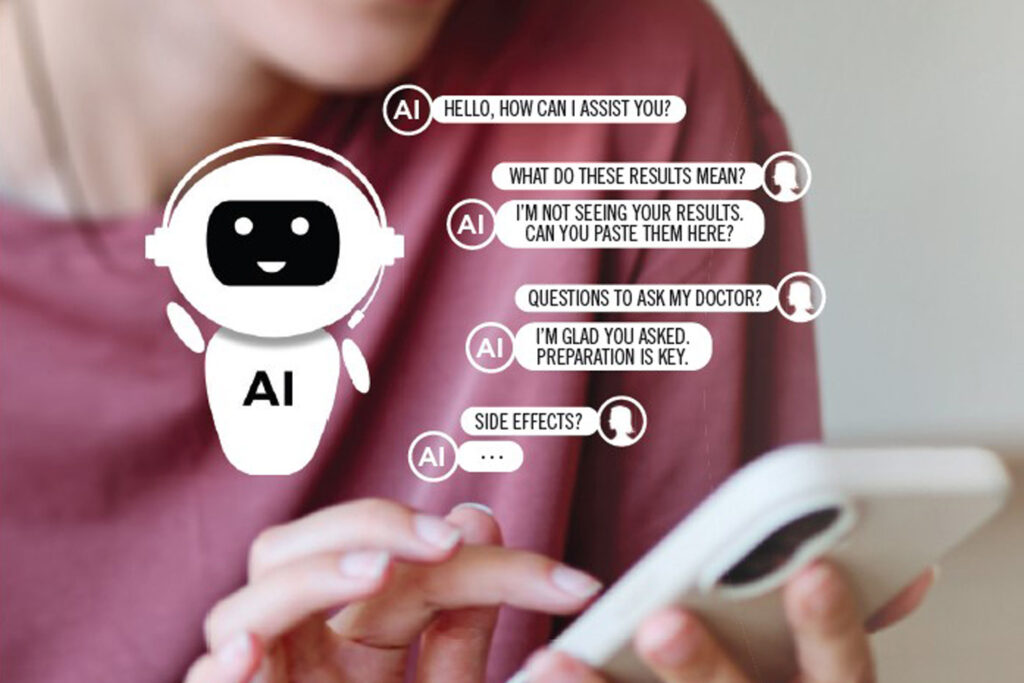
IN OCTOBER 2024, Carolina Millon, a former retail executive in Falls Church, Virginia, anxiously checked her email and found a notification that she had new test results from a recent breast biopsy ready to view. She took a deep breath before clicking on the link. As a carrier of mutations in the BRCA2 and CHEK2 genes, Millon underwent routine screenings every six months, rotating between mammograms and MRIs. She had long planned to schedule a prophylactic double mastectomy after her 40th birthday in December 2024.
While reviewing the biopsy report, Millon tried to work through the jargon and scientific terms. As someone who had done considerable research on her cancer risk, she knew when she read words like “malignant” and “invasive ductal carcinoma” that she had cancer. However, the results came before she had the chance to discuss them with her doctor. Millon became anxious; she didn’t know how aggressive the cancer was or her prognosis. So she turned to ChatGPT, the large language model chatbot developed by OpenAI.
She uploaded a screenshot of the report and asked the chatbot to help her make sense of the results. Within seconds, it had translated the report into plain language, describing the stage of both cancers (one in each breast). “I had a much stronger baseline understanding of what was happening and what those biopsy results meant,” she says. After she read the summary, she requested a list of questions to ask her oncologist for when she called three hours later. Since then, as she’s undergone a mastectomy, chemotherapy, targeted therapy and endocrine therapy, she’s used ChatGPT to help her navigate often-confusing terminology. “It doesn’t replace medical advice,” she says, “but it is a fantastic bridge to help you engage better with your medical team.”