

Astronomy For Kids Recent Work science news

Fast, mysterious clouds swarm around our galaxy

The Milky Way’s forecast: mostly cloudy. But the origin of these cosmic clouds is unclear
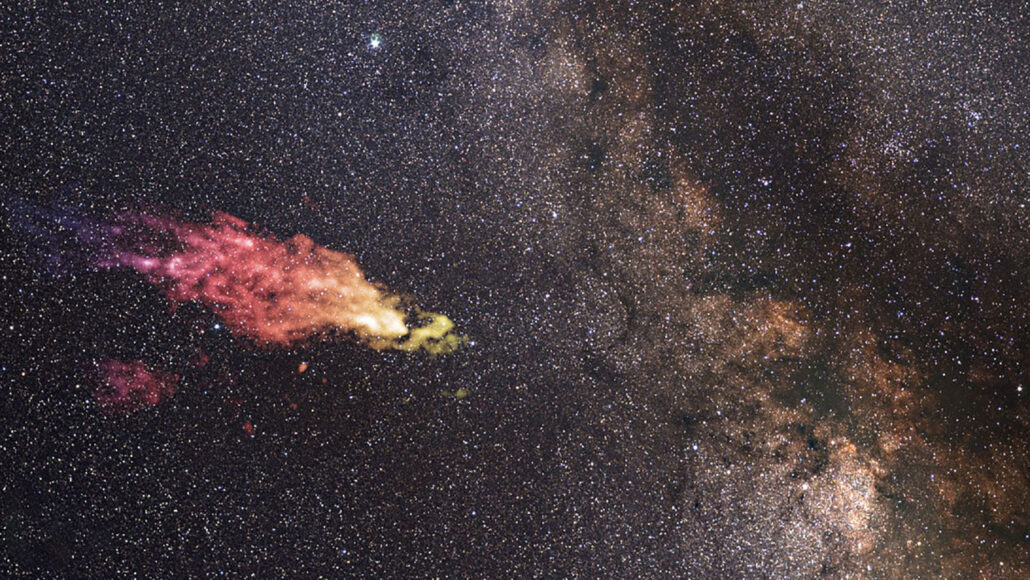
a composite image showing Smith's Cloud and the Milky Way
This composite image shows Smith’s Cloud (reddish, left of center) moving toward the Milky Way. (The image of the Milky Way is a false-color photograph where different colors correspond to radio signals.) One 2016 study found that some 5 million years ago a similar cosmic cloud may have punched a hole in the Milky Way’s disk.NASA/ESA/Levay/STScI, Saxton/Lockman/NRAO/AUI/NSF/Mellinger

Beyond the bright swirling arms of our Milky Way galaxy, something enormous, mysterious and shadowy barrels toward us. It’s called Smith’s Cloud. And it isn’t like any cloud you’ve seen before.

From head to tail, it extends more than 11,000 light-years. That’s roughly 2,500 times the distance from the sun to its closest stellar neighbor.

And Smith’s Cloud is fast. It covers 300 kilometers (nearly 200 miles) every second. That would be fast enough to zoom from Earth to the moon and back in less than an hour.

Instead of ice or water vapor, Smith’s Cloud is a cold gas made mostly of hydrogen.

Most peculiar, though, is where it’s going. Smith’s Cloud doesn’t move in the same direction, or at the same speed, as the stars that make up our galaxy.
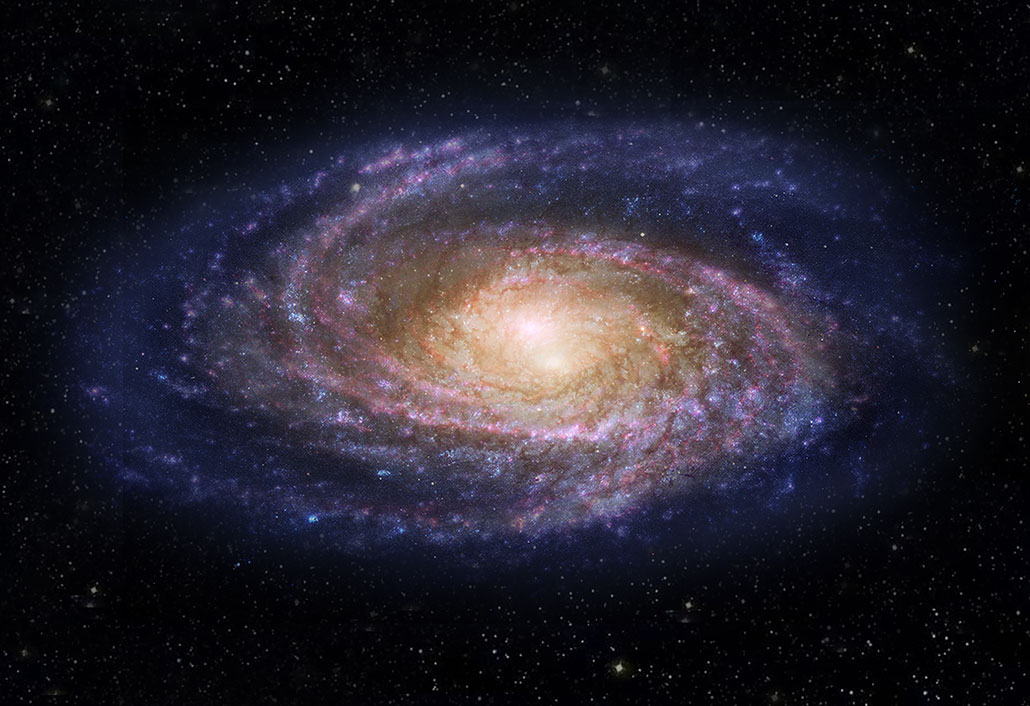
an illustration showing the spiral arms of our galaxy, the Milky Way
Our solar system lies in one of the spiral arms of the Milky Way (seen in an artist’s rendering here). Since we’re inside the galaxy, our telescopes can’t get a glamour shot of its shape. But scientists can tell the Milky Way’s shape from telescope images and good imagery of similar spiral galaxies elsewhere in the cosmos.NASA, ESA, and Z. Levy (STScI)

Read more at Science News Explores.