
Here’s how scientists are solving the “dinosaur death pose” mystery and others.
One bright day in April 2023, Hannah Maddox drove 13 hours from Knoxville, Tennessee, to a U.S. Geological Survey (USGS) research station in the Everglades National Park, near the southern bump of Florida. Her mission was simple: Collect 30 frozen, dead Argentine black and white dead tegus, culled as part of a broad effort to curtail the invasive lizards’ spread. The next year, she repeated the journey to collect 30 more.
“I did do two cannonball runs to the Everglades and back,” she laughs. “And we thank you for that,” says paleoecologist Stephanie Drumheller-Horton, who sent Maddox, a graduate student at the University of Tennessee, to fetch the tegus.
Tegus make adorable pets but destructive members of the Everglades community. “They eat anything they can, including protected groups of animals,” says Drumheller-Horton. But their appetites were not what made the reptiles interesting to her.
The tegus checked two boxes for an unusual experiment that Drumheller-Horton and Maddox were about to launch back in Knoxville. First, the adorable invasives have a “very sort of generic lizard shape,” Drumheller-Horton says, and second, they were available. She didn’t want to kill any animals for the research, and USGS researchers had agreed to freeze, store, and donate the dead animals.
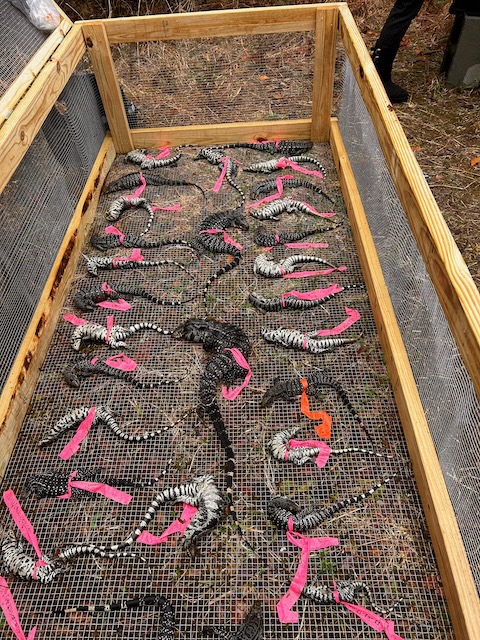
On a muggy day in May, they laid out the thawing, dead lizards in a box a little larger than a coffin, made from a frame of pressure-treated two-by-fours with walls of hardware cloth. Ever since, as season gives over to season, Drumheller-Horton and her students have been watching the creatures fall apart—a process that’s never been so closely studied before. These tegus will help answer a basic science question: How do reptiles decompose?
It’s a major gap in our understanding of nature’s relentless recycling program that has big ramifications: physically big, but also scientifically big. A detailed description of how modern lizards decay could also help reveal ways that ancient ones became fossils.