
Cells commit suicide and rupture; stars explode in spectacular fashion. From the microscopic to the cosmic, demise is inevitable. A Brief History of the End of the Universe and Everything in It is a kaleidoscopic journey to uncover why and how everything comes undone―and why, maybe, that’s okay.
From biology to forensic science to ecology and cosmology, death is not an end but a transformation. The book opens with a visit to a roadside attraction where a man decays in real time, then onto “body farms,” into the deep ocean with whale carcasses, and into space to contemplate the fate of stars―illustrating how, viewed from the right perspective, processes that look destructive reveal an unexpected grace. Disclosing all the gory details as well and the strange beauty of decomposition, A Brief History of the End of the Universe and Everything in It deepens our appreciation of both life and death.
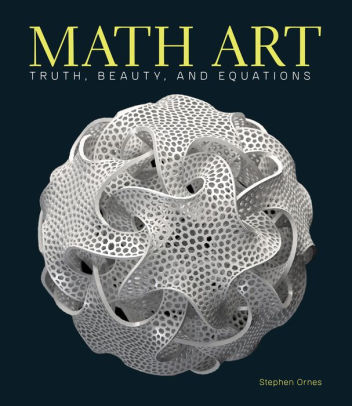
From geometry in motion to the possibilities of pi, this stunning volume reveals how art has been inspired by the beauty and poetry of mathematical principles.
The worlds of visual art and mathematics come together in this volume, presenting more than 80 pieces, including a crocheted, colorful representation of non-Euclidian geometry that looks like sea coral and a 65-ton, 28-foot-tall bronze sculpture covered in a space-filling curve. For each work, we get the artist’s story followed by accessible and thought-provoking explanations of the mathematical concept and equations behind the art.
From 3D-printed objects that give real form to abstract mathematical theories, to mystic fractals, to Andy Warhol as a solution to the Traveling Salesman Problem, these artworks embody some of strangest, most beautiful relationships among numbers and across dimensions.
During the French Revolution, Sophie German taught herself calculus by candlelight. Because women couldn’t study at the leading research institution, she impersonated a male student to be able to continue her math education. Unheralded and often overlooked, Sophie Germain made significant contributions to the theory of elasticity and insights into Fermat’s Last Theorem.